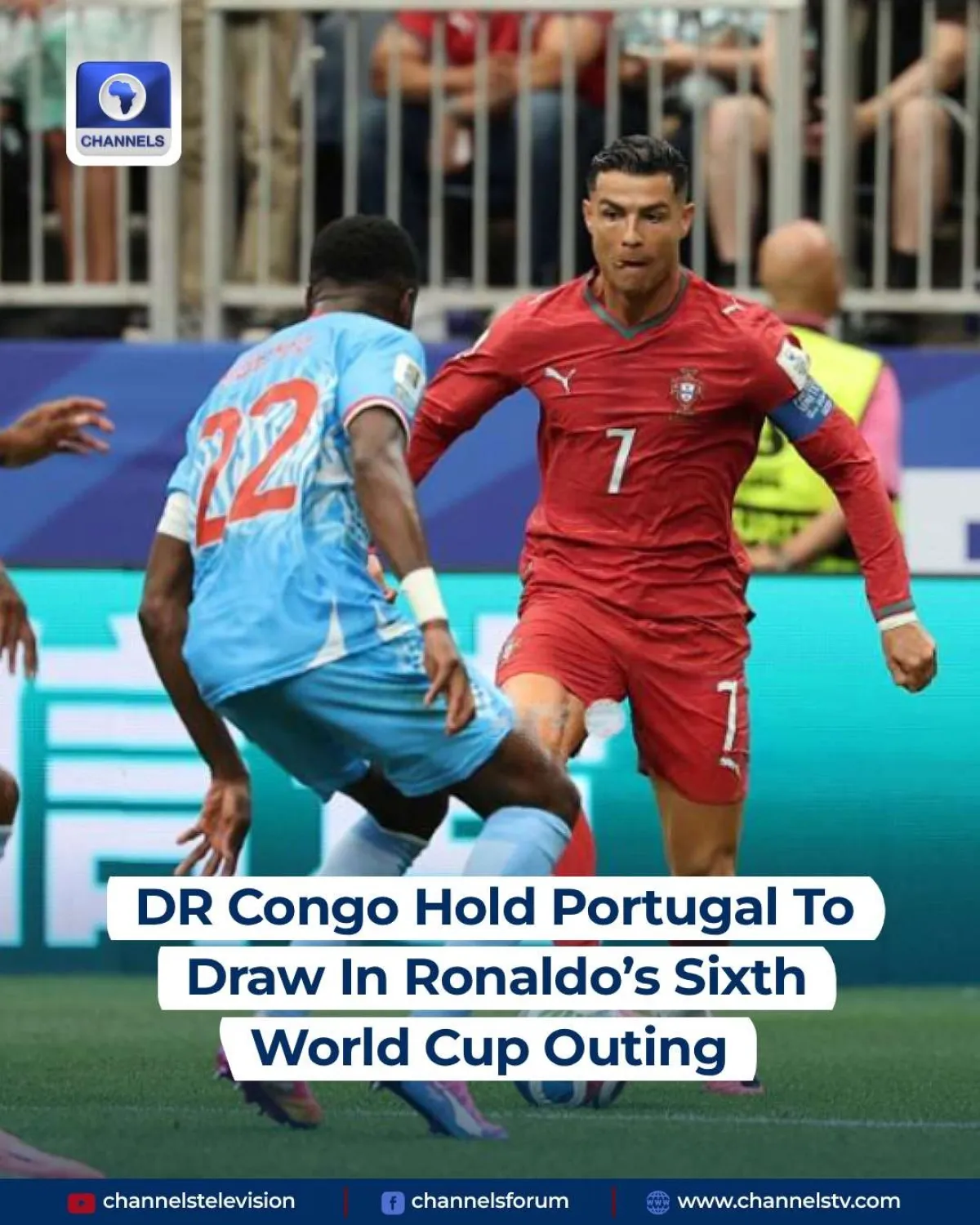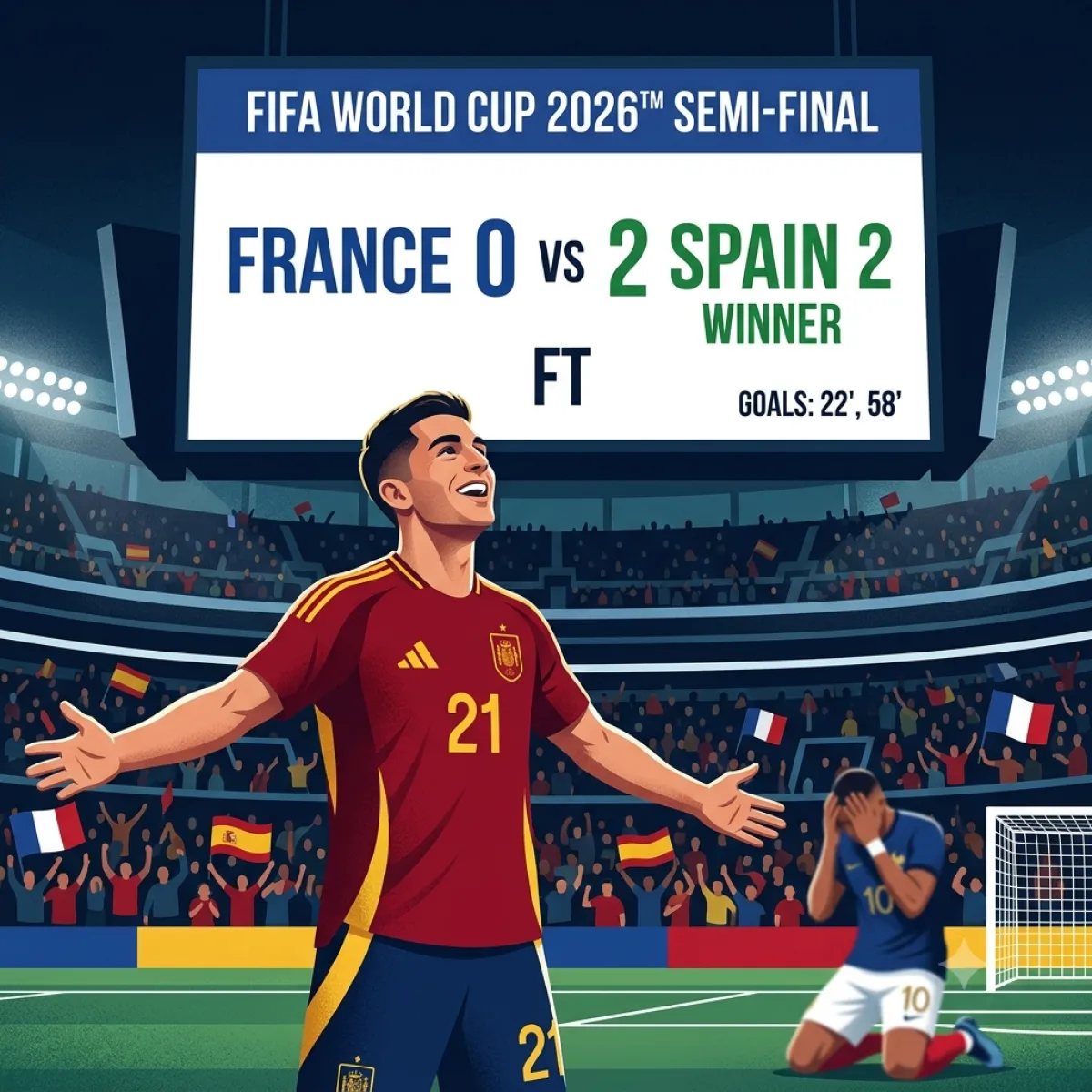
France had more of everything that is supposed to matter. Fourteen shots to ten. Four on target to two. Seven corners to one.
They are going home on Saturday to play for third place.
Spain put two shots on target across ninety minutes and both went in. There is a temptation to build a tactical masterclass out of that, and it should probably be resisted, because what happened here was simpler. Two boxes decided this game. In one, Unai Simón saved everything France could put on him. In the other, Mike Maignan did not make a single save all night,the only two shots that reached him were already past him.
Deschamps Was Fixing the
Game by Half-Time. De la Fuente Never Touched It.
The clearest reading of this semi-final is not in the possession column, which sat at a near dead heat of 51-49. It is in the substitution log.
France made their first change on thirty minutes, eight minutes after going behind, and it was forced rather than chosen: an injury. Another at half-time. A third on fifty-seven. Deschamps had spent three of his five substitutions before the hour, then conceded the second goal roughly sixty seconds after the third one came on.
Spain did not make a single change until the seventy-fourth minute.
That is a manager watching a game he recognises. De la Fuente had nothing to solve. Rodri, Fabián Ruiz and Dani Olmo were still on the pitch at the point most managers begin protecting a lead, because nothing had yet threatened it.
The Corner Count Told a Story the Scoreline Contradicted
Seven corners to one is a territorial thrashing. France camped. They got round the outside, they forced clearances, they made Spain defend for long stretches.
And then nothing arrived. Of France's fourteen attempts, four were blocked before they reached the goal and six missed it altogether. The four that got through found Simón, and not one beat him. A team can spend an hour in the opposition half without ever really being in the match.
Mbappé, Dembélé and Barcola all started. Between them the French front line produced a shot count that wins most games and a goal count of zero. Whether that reflects Spanish organisation or French wastefulness is an argument that will run in Paris until August. The scoreboard does not distinguish.
Spain Are No Longer the Team Their Reputation Describes
Something has shifted here and it is worth naming plainly. The Spain of a decade ago won by never letting you touch the ball. This Spain had fifty-one percent of it.
Fifty-one. They are reaching World Cup finals on a possession share you would call balanced.
The squad list argues otherwise. Yamal, Pedri, Gavi, Nico Williams, Olmo those are names that suggest a side desperate to have the ball and hurt you with it. On Tuesday's evidence they wanted it considerably less than the team sheet implies, and hurt France anyway.
The Margin Was Narrower Than 2-0
It is worth resisting the other temptation too, the one that turns this into a coronation.
France were not outplayed for ninety minutes. They were out-finished. Four saves is a full evening's work for a goalkeeper in a semi-final, and Simón had to be good for all four. Reverse two moments — one save, one Spanish finish — and this is 1-1 heading to extra time, and nobody writes a word about a new Spanish identity.
That is not a criticism of Spain. Winning the tight ones is the entire job at this stage. But the gap between these teams was two moments wide, and it is worth saying so before the retrospectives harden.
France go to the third-place play-off on Saturday, an occasion nobody has ever genuinely wanted to attend. Spain go to the final on Sunday, having scored twice from two shots on target in the biggest match of their tournament. That is either the most efficient performance of the competition or the luckiest.
The trophy does not ask.
Analysis: The 100 Percent Problem
Spain scored with both shots they put on target. It is worth being precise about what that does and does not tell us, because it is the number the whole match rests on and the one most likely to be misread.
A 100 percent conversion rate is not a skill. It is an outcome. Over any sample large enough to be honest with you, that figure collapses toward something in the low teens, because that is roughly what shots are worth. Elite finishers do not convert everything. Nobody does. What Spain produced was the far tail of a distribution, and the far tail is where World Cups are decided.
This matters because of the causal story we are tempted to attach. The clean version reads: Spain engineered high-quality chances and took them, France generated volume without threat, therefore Spain's process was superior. It might be true. A box score cannot confirm it.
What the Numbers Actually Support
France produced fourteen attempts and had ten stopped before they reached the goalkeeper, four blocked, six off target. That profile is consistent with a side striking from distance or from congested positions. It is also consistent with several other things, and consistency is not evidence.
Simón made four saves and conceded none. Maignan made zero and conceded twice. That is the swing of the match stated as plainly as it can be. Both Spanish attempts on target were good enough to beat an international goalkeeper. None of France's four were.
Spain took one corner all night. One. A side that wins 2-0 while generating a single set-piece has scored twice from open play against a defence containing Saliba and Upamecano, which is difficult and probably not accidental.
The Bench as Evidence
The substitution pattern is the strongest tactical signal available, and it is behavioural rather than statistical, which makes it harder to fake.
Deschamps used three changes by fifty-seven minutes. De la Fuente used none until seventy-four. Managers reveal their read of a match through their bench more honestly than through their press conference, and these two read the same ninety minutes very differently. One saw a problem needing intervention from the half-hour. The other saw a game going to plan for three-quarters of its length.
That asymmetry is real, and a scoreline alone would not tell you.
The Honest Conclusion
Spain won a semi-final they were arguably not the better side in on volume, by being better in the two places that convert volume into result. That is a legitimate way to win a football match and it is how a great many of them are won.
Whether it constitutes a tactical identity or a very good evening is a question ninety minutes cannot answer. Sunday might.